OUR SAINTS
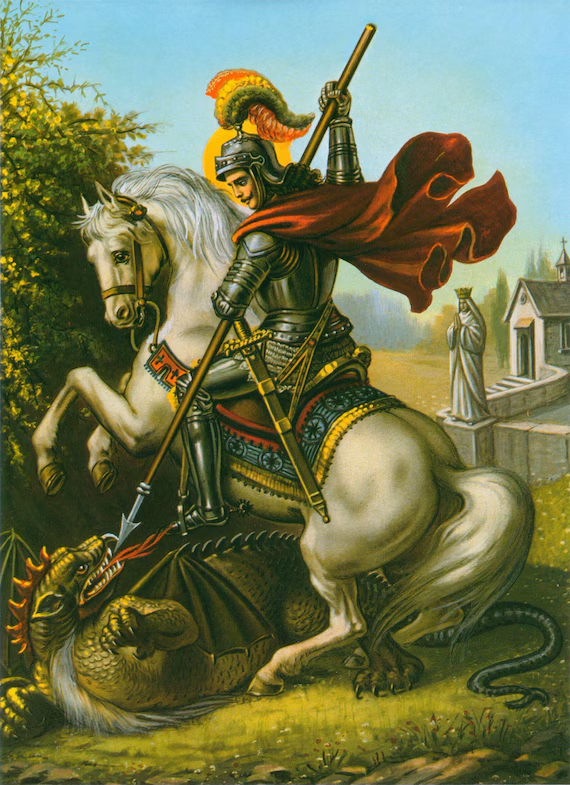
St. George the Prince of Martyrs
Saint George was born in Cappadocia in the early third century to a devout Christian family and was raised in the faith after the death of his father. Known for his courage and wisdom, he became a respected military commander before boldly confessing his faith in Christ during a time of Christian persecution. Despite enduring severe torture and refusing to worship idols, St. George remained steadfast in his faith and became known for the miracles that occurred through him. He ultimately accepted martyrdom by beheading, receiving the crown of eternal life, and remains one of the most beloved and venerated martyrs in Christian history.
St. Rueiss
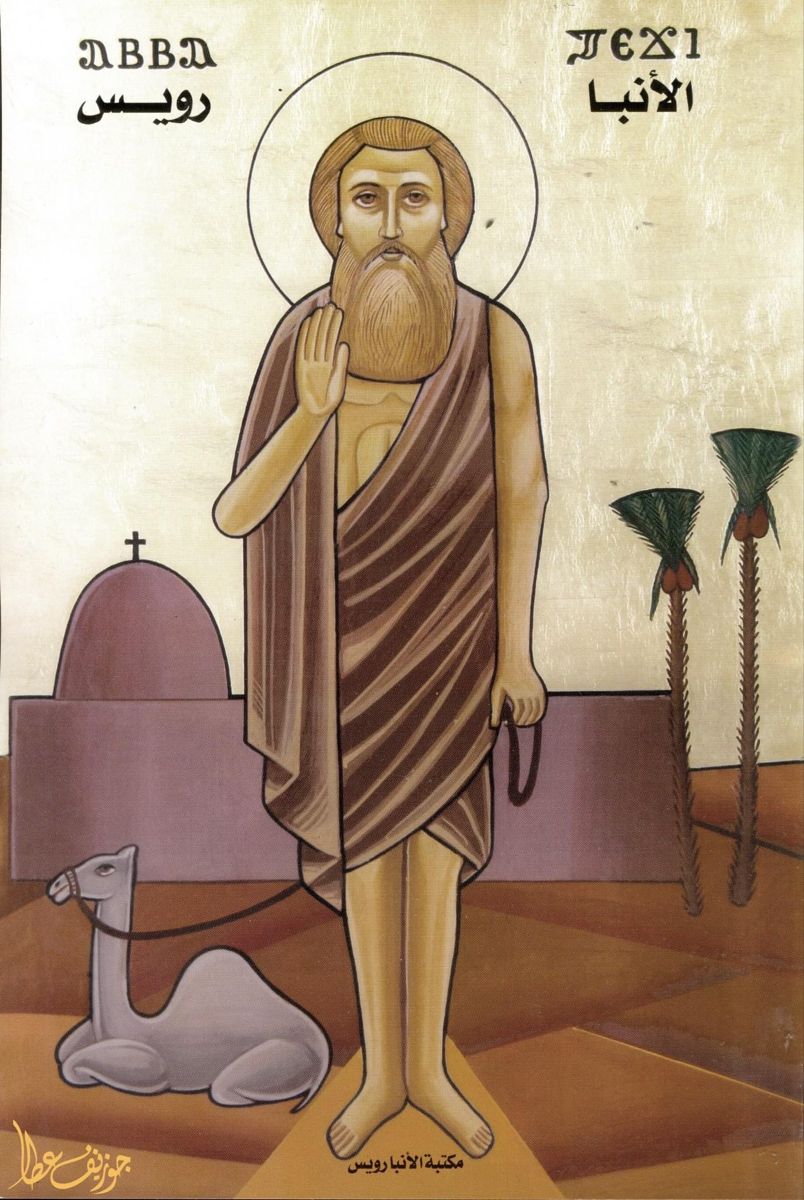
Saint Rueiss, also known as Anba Rueiss, was born in Egypt in 1405 AD to a humble Christian family and grew up in poverty, learning honesty, simplicity, and hard work from a young age. As a young man, he left his village and dedicated his life entirely to prayer, fasting, and asceticism, choosing a life without possessions or worldly comfort. Though quiet and humble, St. Rueiss became known for his deep spirituality, love for the poor, and the divine gifts granted to him, including prophecy and spiritual insight. Despite enduring persecution, suffering, and years of illness, he remained patient and faithful until his peaceful repose. He is remembered as one of the great saints of humility, purity, and spiritual wisdom in the Coptic Orthodox Church.
St. George
Early Life and Background
On this day, the great among the martyrs, St. George, was martyred. He was born in Cappadocia in the early third century into a wealthy and devout Christian family. His father, Anastasius, was a governor in Melitene, and his mother, Theopista, came from a noble Christian family in Palestine. After his father’s death while he was still young, his mother raised him and his sisters Kasia and Mathrona in Lydda, instilling in them strong Christian values and piety.
Military Life and Confession of Faith
As a young man, St. George became known for his courage and intelligence. He joined the army under the governor Justus of Palestine and quickly rose through the ranks until he became a commander. After the governor’s death, George sought advancement and came before King Dadianus in Syria. There he encountered an edict commanding the worship of idols and persecution of Christians.
Before the king, George boldly confessed his faith in Christ and refused all offers of wealth and honor in exchange for idol worship. Enraged, the king ordered him to be subjected to severe and repeated tortures. He was beaten, bound, and exposed to cruel punishments, yet through all of it he remained peaceful, unharmed in spirit, and steadfast in faith.
Miracles, Final Witness, and Martyrdom
Even in suffering, St. George witnessed miracles. He survived poison, endured torture without lasting harm, and caused the destruction of idols in the pagan temple, leading some to believe in Christ. Despite these signs, the king remained hardened and ultimately ordered his execution.
St. George prayed before his death and peacefully accepted martyrdom by beheading, receiving the crown of eternal life. His body was taken to Lydda, where a church was later built in his honor, and he became one of the most venerated martyrs in Christian tradition.
Early Life and Background
On this day, the great among the martyrs, St. George, was martyred. He was born in Cappadocia in the early third century into a wealthy and devout Christian family. His father, Anastasius, was a governor in Melitene, and his mother, Theopista, came from a noble Christian family in Palestine. After his father’s death while he was still young, his mother raised him and his sisters Kasia and Mathrona in Lydda, instilling in them strong Christian values and piety.
Military Life and Confession of Faith
As a young man, St. George became known for his courage and intelligence. He joined the army under the governor Justus of Palestine and quickly rose through the ranks until he became a commander. After the governor’s death, George sought advancement and came before King Dadianus in Syria. There he encountered an edict commanding the worship of idols and persecution of Christians.
Before the king, George boldly confessed his faith in Christ and refused all offers of wealth and honor in exchange for idol worship. Enraged, the king ordered him to be subjected to severe and repeated tortures. He was beaten, bound, and exposed to cruel punishments, yet through all of it he remained peaceful, unharmed in spirit, and steadfast in faith.
Miracles, Final Witness, and Martyrdom
Even in suffering, St. George witnessed miracles. He survived poison, endured torture without lasting harm, and caused the destruction of idols in the pagan temple, leading some to believe in Christ. Despite these signs, the king remained hardened and ultimately ordered his execution.
St. George prayed before his death and peacefully accepted martyrdom by beheading, receiving the crown of eternal life. His body was taken to Lydda, where a church was later built in his honor, and he became one of the most venerated martyrs in Christian tradition.
St. Rueiss
Early Life and Humble Beginnings
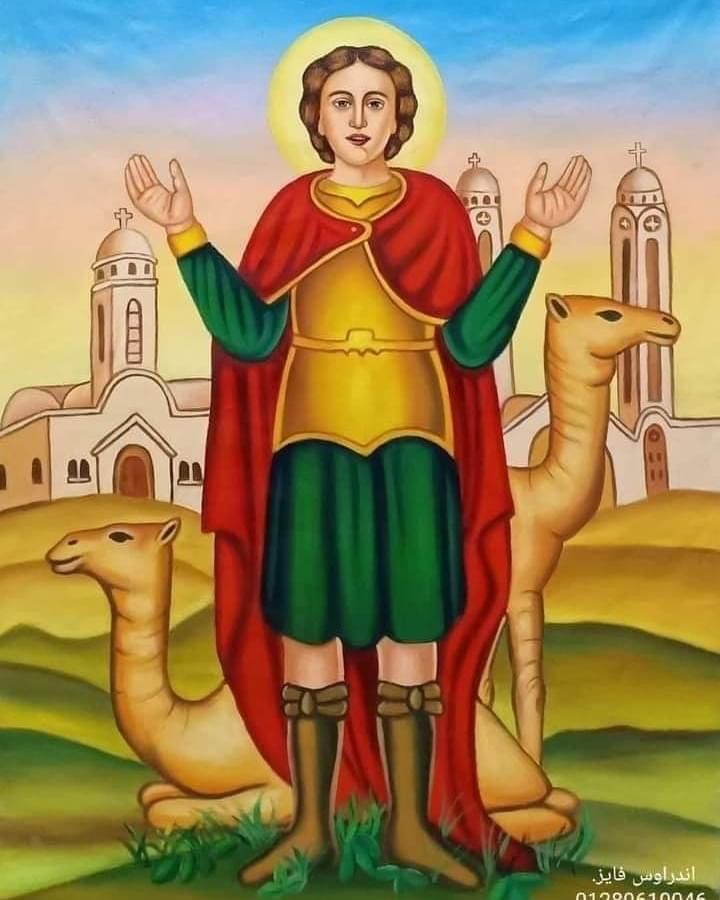
In the year 1121 of the Martyrs (1405 AD), the great saint Abba Freig, known as Anba Rueiss, reposed. He was born in the small village of Minyat Bimin in the Gharbiya governorate to humble Christian parents, Isaac and Sarah. Raised in poverty, he learned early the values of hard work, honesty, and simplicity. He helped his father in farming and also sold salt transported by a small camel, becoming known for his integrity and gentleness.
Life of Asceticism and Spiritual Gifts
At around twenty years of age, he left his village and traveled to Cairo, then to Upper Egypt. In a sign of humility, he changed his name from Freig to Rueiss, after his small camel. From that point, he embraced a life of complete poverty, wandering without home or possessions, devoted entirely to prayer, fasting, and spiritual discipline.
He lived quietly and rarely spoke, yet his life was filled with deep spiritual experience. He regularly received the Holy Mysteries with great reverence, often describing the altar as a place where the glory of God was revealed. God granted him spiritual gifts, including prophecy and the ability to perceive divine mysteries, and the Church called him “Theophanius,” meaning “he to whom God appears.”
Trials, Patience, and Repose
St. Rueiss endured persecution when wicked men beat him and brought him before a ruler, yet he remained silent and patient. He was severely tortured and later imprisoned with his disciple, but was later released and cared for by Pope Matthew I until he recovered.
Despite the Pope’s request that he remain in the patriarchal residence, he returned to his life of wandering and service to the poor, especially widows and orphans. In his later years, he suffered a long illness lasting nine years, which he bore with gratitude and peace.
Before his repose, the Virgin Mary appeared to comfort him. He made the sign of the cross and peacefully gave up his soul. He was buried at Dayr al-Khandaq, which later became named after him, and he is remembered as one of the great saints of humility and spiritual wisdom.
Early Life and Humble Beginnings
In the year 1121 of the Martyrs (1405 AD), the great saint Abba Freig, known as Anba Rueiss, reposed. He was born in the small village of Minyat Bimin in the Gharbiya governorate to humble Christian parents, Isaac and Sarah. Raised in poverty, he learned early the values of hard work, honesty, and simplicity. He helped his father in farming and also sold salt transported by a small camel, becoming known for his integrity and gentleness.
Life of Asceticism and Spiritual Gifts
At around twenty years of age, he left his village and traveled to Cairo, then to Upper Egypt. In a sign of humility, he changed his name from Freig to Rueiss, after his small camel. From that point, he embraced a life of complete poverty, wandering without home or possessions, devoted entirely to prayer, fasting, and spiritual discipline.
He lived quietly and rarely spoke, yet his life was filled with deep spiritual experience. He regularly received the Holy Mysteries with great reverence, often describing the altar as a place where the glory of God was revealed. God granted him spiritual gifts, including prophecy and the ability to perceive divine mysteries, and the Church called him “Theophanius,” meaning “he to whom God appears.”
Trials, Patience, and Repose
St. Rueiss endured persecution when wicked men beat him and brought him before a ruler, yet he remained silent and patient. He was severely tortured and later imprisoned with his disciple, but was later released and cared for by Pope Matthew I until he recovered.
Despite the Pope’s request that he remain in the patriarchal residence, he returned to his life of wandering and service to the poor, especially widows and orphans. In his later years, he suffered a long illness lasting nine years, which he bore with gratitude and peace.
Before his repose, the Virgin Mary appeared to comfort him. He made the sign of the cross and peacefully gave up his soul. He was buried at Dayr al-Khandaq, which later became named after him, and he is remembered as one of the great saints of humility and spiritual wisdom.
St. Anthony
Early Life and Calling to the Desert
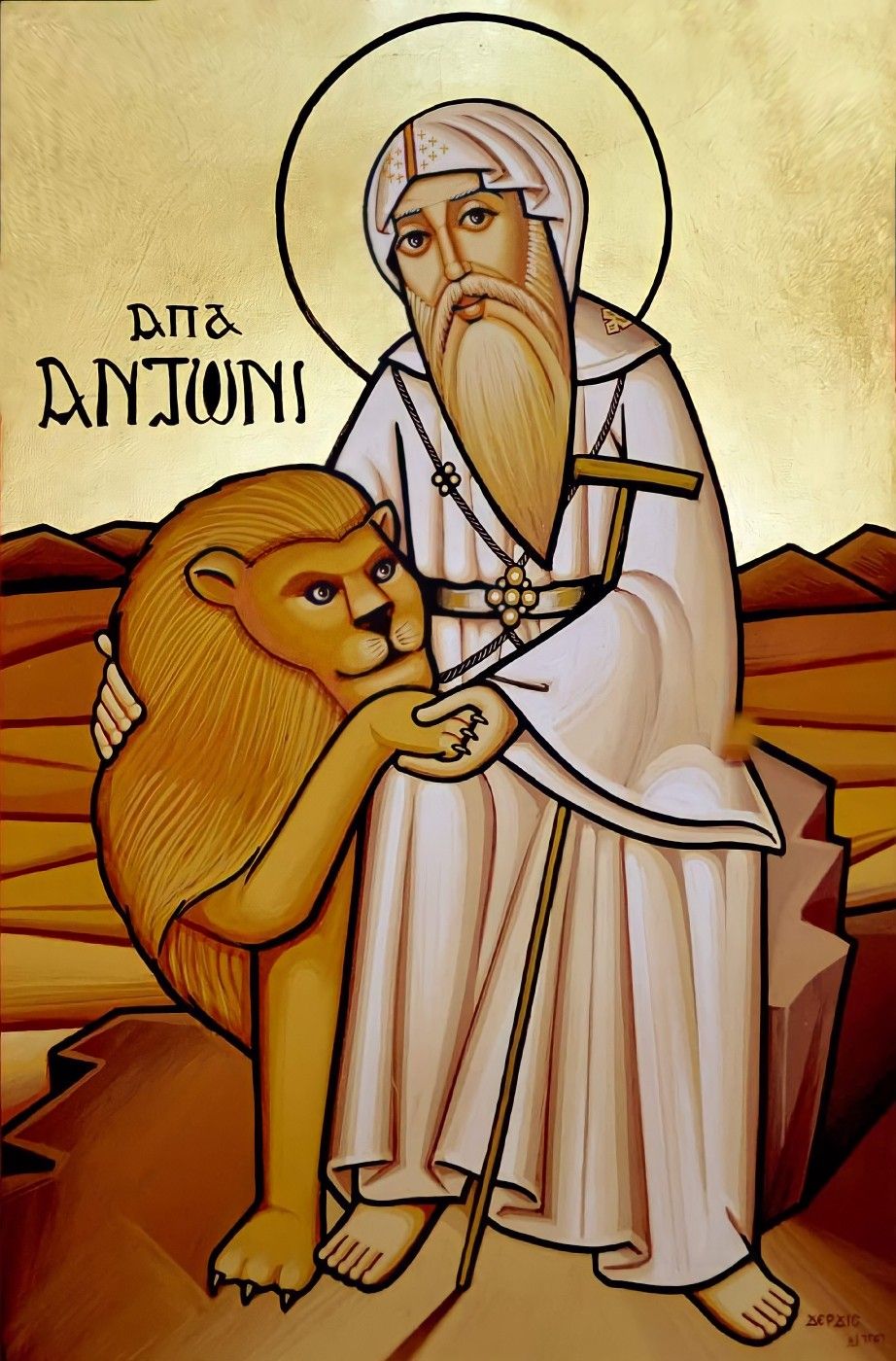
In the year 72 of the Martyrs (356 AD), the great Saint Antony, the luminary of the desert and father of all monks, departed. He was born in 251 AD in the village of Qumn al-Arus to wealthy Christian parents who were known for their love of the poor and their devotion to God.
After the death of his father, Antony was deeply moved by the thought of mortality as he stood by his body, reflecting on the temporary nature of worldly life. His heart turned toward eternity, and he renounced the pursuit of wealth, inspired by the example of the apostles who left everything to follow Christ.
His calling became even stronger when he heard the Gospel in church saying: “If you want to be perfect, go, sell what you have and give to the poor, and you will have treasure in heaven; and come, follow Me.” This verse deeply penetrated his heart.
He obeyed immediately, selling all his possessions, providing for his sister, and giving the remainder to the poor and the Church. He then withdrew from the world, living first in a small hut near the Nile, and later in an old tomb in the desert. There, he learned ascetic life by visiting other monks and practicing their virtues.
Life of Asceticism, Spiritual Warfare, and Monastic Leadership
St. Antony eventually settled in a remote cave in the eastern desert near a well, where he lived in fasting, prayer, and continuous spiritual struggle against demonic attacks. He endured severe trials, including physical assaults, yet God strengthened him and granted him victory.
He remained in this solitude for about twenty years until many people gathered around him, seeking healing and spiritual guidance. Coming out of seclusion, he became a source of blessing for many, performing miracles through the grace of God.
Many disciples gathered around him, forming communities in the surrounding desert. Through this, he established the first organized monastic system in Christian history, and he became known as the “Father of Monks.”
He visited Alexandria twice—once during persecution to strengthen the faithful, and later to defend Orthodox faith alongside St. Athanasius against the Arians. He was honored by emperors, philosophers, and church leaders alike, and even corresponded with Emperor Constantine, offering spiritual guidance and prayers for the empire.
In his final days, he instructed his disciples, entrusted them with his belongings, and asked to be buried in a hidden place. After completing his long and righteous struggle, he peacefully departed at the age of 105, giving his soul into the hands of the Lord.
Early Life and Calling to the Desert
In the year 72 of the Martyrs (356 AD), the great Saint Antony, the luminary of the desert and father of all monks, departed. He was born in 251 AD in the village of Qumn al-Arus to wealthy Christian parents who were known for their love of the poor and their devotion to God.
After the death of his father, Antony was deeply moved by the thought of mortality as he stood by his body, reflecting on the temporary nature of worldly life. His heart turned toward eternity, and he renounced the pursuit of wealth, inspired by the example of the apostles who left everything to follow Christ.
His calling became even stronger when he heard the Gospel in church saying: “If you want to be perfect, go, sell what you have and give to the poor, and you will have treasure in heaven; and come, follow Me.” This verse deeply penetrated his heart.
He obeyed immediately, selling all his possessions, providing for his sister, and giving the remainder to the poor and the Church. He then withdrew from the world, living first in a small hut near the Nile, and later in an old tomb in the desert. There, he learned ascetic life by visiting other monks and practicing their virtues.
Life of Asceticism, Spiritual Warfare, and Monastic Leadership
St. Antony eventually settled in a remote cave in the eastern desert near a well, where he lived in fasting, prayer, and continuous spiritual struggle against demonic attacks. He endured severe trials, including physical assaults, yet God strengthened him and granted him victory.
He remained in this solitude for about twenty years until many people gathered around him, seeking healing and spiritual guidance. Coming out of seclusion, he became a source of blessing for many, performing miracles through the grace of God.
Many disciples gathered around him, forming communities in the surrounding desert. Through this, he established the first organized monastic system in Christian history, and he became known as the “Father of Monks.”
He visited Alexandria twice—once during persecution to strengthen the faithful, and later to defend Orthodox faith alongside St. Athanasius against the Arians. He was honored by emperors, philosophers, and church leaders alike, and even corresponded with Emperor Constantine, offering spiritual guidance and prayers for the empire.
In his final days, he instructed his disciples, entrusted them with his belongings, and asked to be buried in a hidden place. After completing his long and righteous struggle, he peacefully departed at the age of 105, giving his soul into the hands of the Lord.
St. Paul
Renunciation and Life in the Wilderness
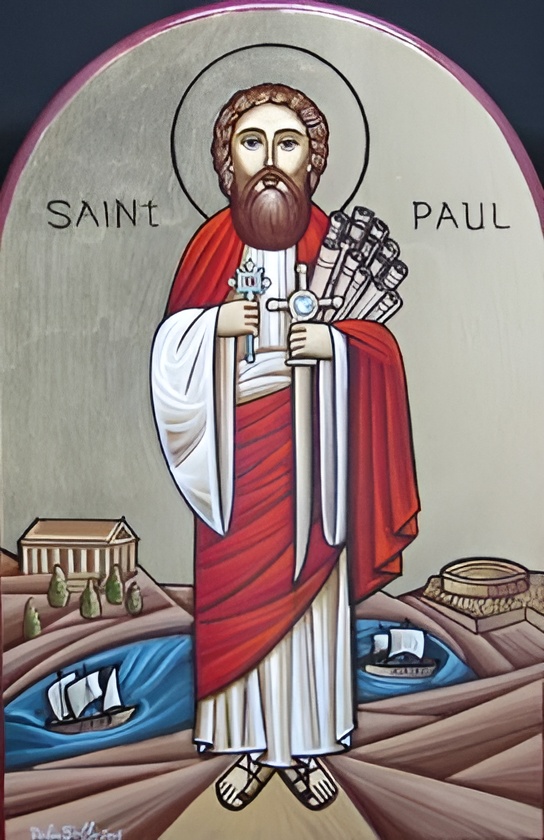
In the year 57 of the Martyrs (341 AD), the great saint Abba Paul, the first anchorite, departed. He was born in the city of Thebes and had a brother named Peter. After their father’s death, they divided the inheritance, but conflict arose as Peter claimed a larger portion. While on their way to a judge to settle the dispute, they passed a funeral procession of a wealthy man. Deeply moved, Paul reflected on the emptiness of worldly possessions and decided to abandon all claims, telling his brother he wanted nothing.
He left the city and withdrew into solitude, settling in a cemetery where he prayed for three days, asking God to guide him. God then sent His angel to lead him into the inner desert, where he lived alone for seventy years, unseen by the world. He wore a garment of palm fibers, and God miraculously provided him daily sustenance through a crow that brought him bread.
In this hidden life of asceticism, St. Paul became a vessel of holiness, and through his prayers, God granted rain and fertility to the earth. His life remained completely concealed, dedicated to prayer, fasting, and divine communion.
Encounter with St. Antony and Holy Repose
God revealed St. Paul’s holiness to St. Antony, instructing him to seek the hermit in the inner wilderness. Antony traveled and found him in his cave, where they bowed to one another and spoke of the greatness of God. That day, a crow brought a full loaf of bread, signifying God’s providence.
St. Paul then knew his time had come and asked Antony to bring the garment of Emperor Constantine given to Patriarch Athanasius. On his return journey, Antony saw angels carrying Paul’s soul to heaven, and upon arriving, found that the saint had reposed peacefully.
With divine guidance, two lions dug a grave for his body, and Antony buried him with reverence, taking his palm-fiber garment. He later informed Pope Athanasius, who honored the saint greatly. The Pope could not locate the body afterward but kept the garment and wore it on major feasts in remembrance.
St. Philopateer
Early Life and Military Calling
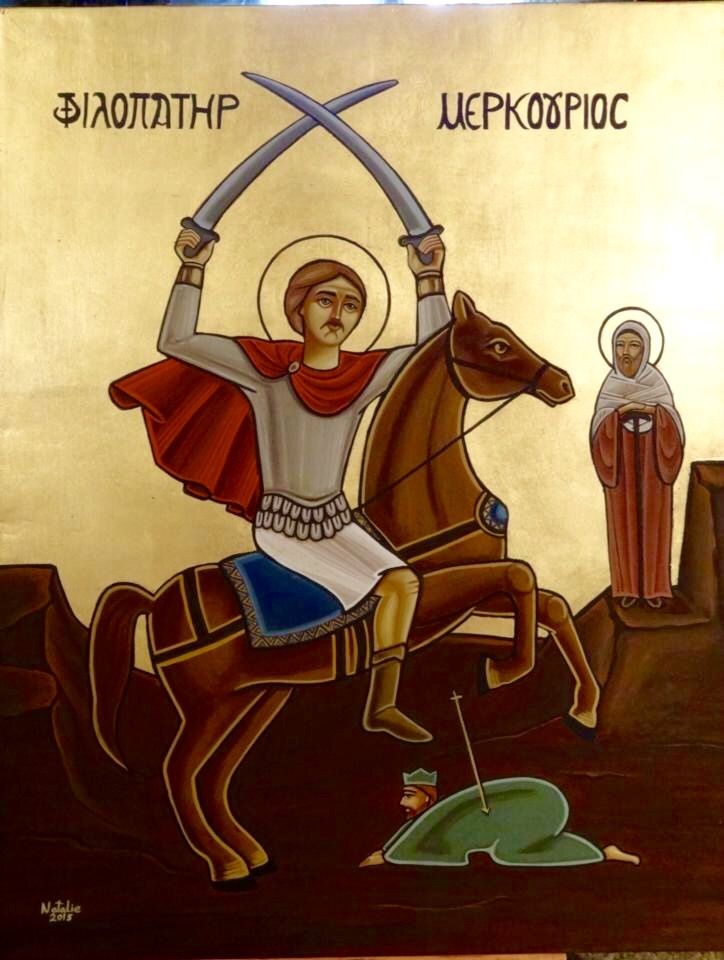
In the year 250 A.D., St. Mercurius, known as Abu Sayfayn (the owner of the two swords), was martyred. He was born in the early third century in Rome to Christian parents who named him Philopater, meaning “Lover of the Father.” He was raised in a devout Christian home and grew up in the fear of God.
As a young man, he joined the Roman army during the reign of Emperor Decius. Because of his courage, strength, and discipline, he quickly gained the admiration of the emperor, who renamed him Mercurius. During a war against invading barbarians, the emperor became fearful due to the enemy’s strength, but Mercurius encouraged him, assuring him that God would grant victory.
That night, an angel of the Lord appeared to him in white garments and gave him a sword, saying that victory would come from God and should always be remembered as His work. Because of this vision, he became known as Abu Sayfayn, the “owner of two swords”—the physical sword of battle and the spiritual sword of divine power.
Through God’s help, the Romans were victorious, and Mercurius was honored greatly. He was appointed Supreme Commander of the Roman armies and highly respected by all. However, he always declared that the victory belonged to God alone, not to him.
Confession of Faith and Martyrdom
After the war, the emperor and soldiers went to offer incense to idols, but St. Mercurius refused to participate. When questioned, he openly confessed his faith in Christ and declared that the victory had come through the Lord Jesus Christ. The emperor offered him a choice between his military rank and his Christian faith, but he rejected all honors and laid down his military garments, choosing Christ alone.
The emperor became enraged and ordered him to be tortured. Despite severe beatings and cruel punishments, St. Mercurius remained steadfast in his faith. Many were inspired by his endurance and accepted Christianity, some of whom also became martyrs.
Seeing his influence, the emperor ordered him bound in iron chains and sent to Caesarea, where he was beheaded and received the crown of martyrdom. Through his witness, St. Mercurius became a powerful example of courage, faith, and complete devotion to Christ.
Early Life and Military Calling
In the year 250 A.D., St. Mercurius, known as Abu Sayfayn (the owner of the two swords), was martyred. He was born in the early third century in Rome to Christian parents who named him Philopater, meaning “Lover of the Father.” He was raised in a devout Christian home and grew up in the fear of God.
As a young man, he joined the Roman army during the reign of Emperor Decius. Because of his courage, strength, and discipline, he quickly gained the admiration of the emperor, who renamed him Mercurius. During a war against invading barbarians, the emperor became fearful due to the enemy’s strength, but Mercurius encouraged him, assuring him that God would grant victory.
That night, an angel of the Lord appeared to him in white garments and gave him a sword, saying that victory would come from God and should always be remembered as His work. Because of this vision, he became known as Abu Sayfayn, the “owner of two swords”—the physical sword of battle and the spiritual sword of divine power.
Through God’s help, the Romans were victorious, and Mercurius was honored greatly. He was appointed Supreme Commander of the Roman armies and highly respected by all. However, he always declared that the victory belonged to God alone, not to him.
Confession of Faith and Martyrdom
After the war, the emperor and soldiers went to offer incense to idols, but St. Mercurius refused to participate. When questioned, he openly confessed his faith in Christ and declared that the victory had come through the Lord Jesus Christ. The emperor offered him a choice between his military rank and his Christian faith, but he rejected all honors and laid down his military garments, choosing Christ alone.
The emperor became enraged and ordered him to be tortured. Despite severe beatings and cruel punishments, St. Mercurius remained steadfast in his faith. Many were inspired by his endurance and accepted Christianity, some of whom also became martyrs.
Seeing his influence, the emperor ordered him bound in iron chains and sent to Caesarea, where he was beheaded and received the crown of martyrdom. Through his witness, St. Mercurius became a powerful example of courage, faith, and complete devotion to Christ.
St. Shenouda
Early Life, Calling, and Monastic Formation
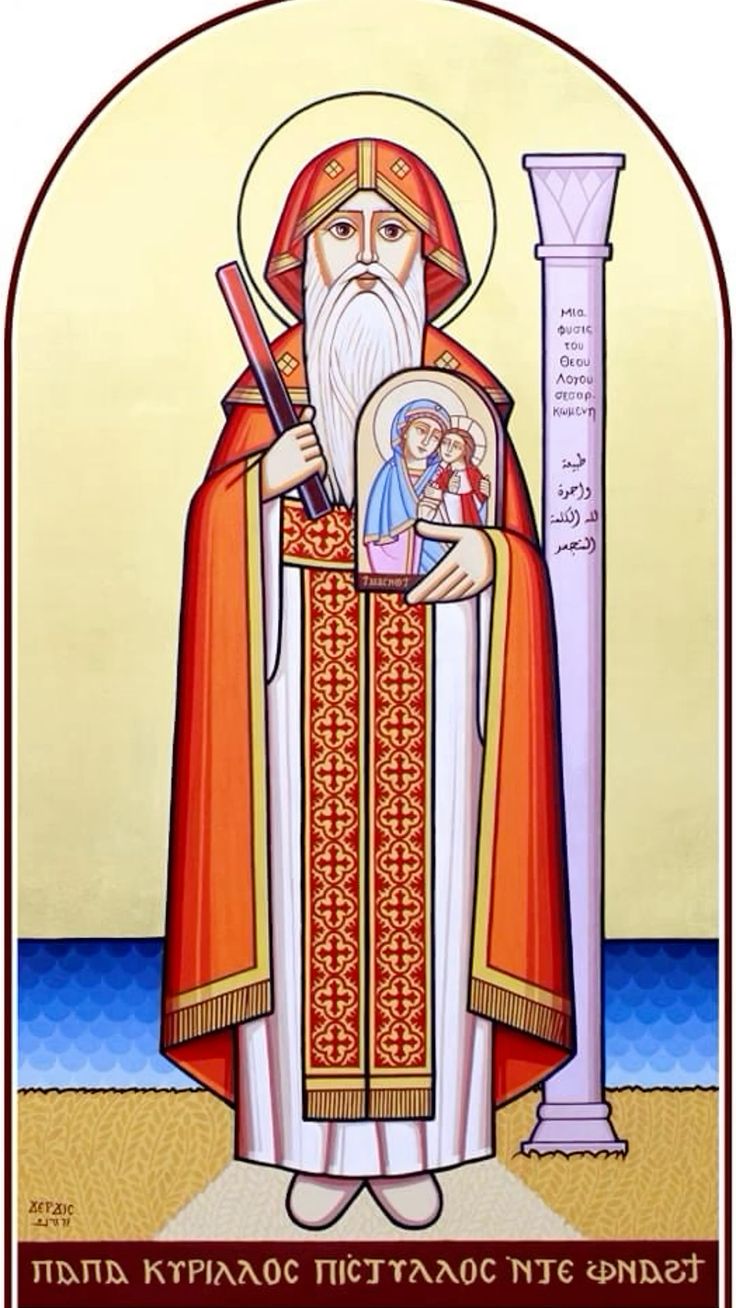
In the year 168 of the Martyrs (452 AD), the great Saint Anba Shenoute, the Archimandrite, departed. He was born in the village of Shatlala (Shandawil) to devout Christian parents, Bagoush and Diruba, who raised him in love for piety and virtue.
From childhood, Shenoute preferred solitude and prayer. At the age of nine, he was sent to tend sheep, where he spent his days fasting, giving his food to others, and separating himself to pray. One of the shepherds once saw him in prayer and witnessed a miraculous light surrounding him, with his fingers appearing like burning candles and a fragrance like incense filling the air.
When his parents learned of this, they took him to the monastery of his uncle, Anba Pigol, so he could grow in spiritual life. There, Anba Pigol received him in a prophetic spirit, recognizing that he was chosen by God to become a great father and leader of monks. He later saw a vision of an angel instructing him to clothe Shenoute in the monastic habit, declaring that he would become a father to many.
Shenoute was thus tonsured and began his monastic life, growing rapidly in prayer, asceticism, and humility. He overcame demonic temptations through fasting, prayer, and the sign of the cross, remaining steadfast in spiritual warfare.
Leadership, Ministry, and Spiritual Legacy
After the departure of Anba Pigol, Shenoute was chosen as head of the monastery because of his deep spirituality and discipline. He led a monastic community of nearly 2,500 monks, establishing strict rules for life, prayer, work, and study, ensuring a life of order and holiness.
He emphasized education, manual labor, and continuous prayer, guiding monks toward a life of purity and dedication. At one point, he remained in intense prayer and contemplation for five years, after which he heard a divine voice confirming his spiritual leadership over the solitaries.
His influence extended beyond the monastery to the laity. He opened the monastery for the poor and needy, built churches in nearby villages, and defended the oppressed before authorities. He also became a strong supporter of Coptic identity, language, and heritage.
Saint Shenoute accompanied Pope Cyril I to the Council of Ephesus in 431 AD, where Nestorius was condemned. Because of his influence, Nestorius was later exiled near Shenoute’s monastery. Shenoute became known for his strong spiritual authority, and it is said that Christ Himself appeared to him on several occasions.
After a life of 120 years spent in ascetic struggle, teaching, writing, and serving the Church, he departed in peace and entered eternal rest.
Archangel Michael
Establishment of the Feast of Archangel Michael
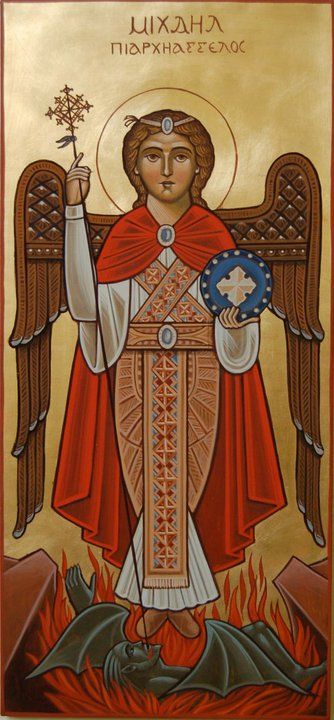
On the 12th of every Coptic month, the Church celebrates the commemoration of the honorable Archangel Michael. In earlier times, the people of Alexandria used to celebrate a pagan feast at the temple of Saturn on the 12th of Hatur each year, during which they offered sacrifices and distributed meat to the poor.
When Pope Alexander, the 19th Patriarch of the See of Saint Mark, learned of this practice, he gathered the faithful and explained that the celebration was originally dedicated to a pagan deity. He instructed them to transform it into a Christian feast in honor of Archangel Michael, the great intercessor before God and protector of humanity. From that time, the celebration continued, but the offerings were given as alms to the poor in the name of Archangel Michael.
The people agreed and the pagan temple was demolished, and in its place a church was built and consecrated on the 12th of Hatur in the name of Archangel Michael, who strengthens and consoles the faithful in their spiritual struggles.
Miracle of Dorotheus and the Provision of God
Among the miracles of Archangel Michael was his appearance to a God-loving man named Dorotheus and his wife Theopista, who annually commemorated the Archangel through acts of charity. One year, they fell into severe poverty and could not afford to celebrate the feast, even considering selling their belongings.
The Archangel Michael appeared to Dorotheus in the form of a magistrate and instructed him to purchase a lamb, a fish, and wheat for the feast, using three gold coins for each. He also told him not to open the fish until instructed.
Dorotheus obeyed and hosted the feast as commanded. After the celebration, the Archangel returned and instructed him to open the fish, inside which he found three hundred gold coins and three pieces of gold. The Archangel told him that God had accepted his charity and rewarded him abundantly in this life, and would grant him eternal life in the age to come.
Then the Archangel revealed himself fully, saying: “I am the Archangel Michael, the one who presents your prayers and alms before God.” After comforting them and assuring them of divine providence, he ascended into heaven, and they glorified God for His mercy.
Establishment of the Feast of Archangel Michael
On the 12th of every Coptic month, the Church celebrates the commemoration of the honorable Archangel Michael. In earlier times, the people of Alexandria used to celebrate a pagan feast at the temple of Saturn on the 12th of Hatur each year, during which they offered sacrifices and distributed meat to the poor.
When Pope Alexander, the 19th Patriarch of the See of Saint Mark, learned of this practice, he gathered the faithful and explained that the celebration was originally dedicated to a pagan deity. He instructed them to transform it into a Christian feast in honor of Archangel Michael, the great intercessor before God and protector of humanity. From that time, the celebration continued, but the offerings were given as alms to the poor in the name of Archangel Michael.
The people agreed and the pagan temple was demolished, and in its place a church was built and consecrated on the 12th of Hatur in the name of Archangel Michael, who strengthens and consoles the faithful in their spiritual struggles.
Miracle of Dorotheus and the Provision of God
Among the miracles of Archangel Michael was his appearance to a God-loving man named Dorotheus and his wife Theopista, who annually commemorated the Archangel through acts of charity. One year, they fell into severe poverty and could not afford to celebrate the feast, even considering selling their belongings.
The Archangel Michael appeared to Dorotheus in the form of a magistrate and instructed him to purchase a lamb, a fish, and wheat for the feast, using three gold coins for each. He also told him not to open the fish until instructed.
Dorotheus obeyed and hosted the feast as commanded. After the celebration, the Archangel returned and instructed him to open the fish, inside which he found three hundred gold coins and three pieces of gold. The Archangel told him that God had accepted his charity and rewarded him abundantly in this life, and would grant him eternal life in the age to come.
Then the Archangel revealed himself fully, saying: “I am the Archangel Michael, the one who presents your prayers and alms before God.” After comforting them and assuring them of divine providence, he ascended into heaven, and they glorified God for His mercy.
St. Mina
Birth, Early Life, and Calling to Faith
In the year 25 of the Martyrs (309 AD), the great Saint Mina the Wonder-Worker was martyred. He was born in Nikiou in the late third century to devout Christian parents, Eudoxius, a governor, and Euphemia. His parents were known for their piety and generosity toward the poor, and he was raised in a deeply spiritual home.
His mother Euphemia had long been barren, but through fasting, prayer, and almsgiving, she pleaded with God for a child. During a feast in honor of the Virgin Mary, she prayed before her icon and heard the word “Amen,” which she understood as a divine promise. Soon after, she conceived and gave birth to a son.
The child was originally to be named after his grandfather, but his mother instead named him Mina, connecting it to the word “Amen” she had heard. His birth was celebrated with great joy, and his father gave generously to the poor on that occasion. Mina was raised in faith, learning the Scriptures, attending church regularly, and growing in virtue.
After losing both parents at a young age, he inherited their wealth and distributed it to the poor, choosing a life of humility. He later joined the Roman army and quickly rose in rank due to his noble character and his father’s connections. However, when the emperors Diocletian and Maximian issued an edict enforcing idol worship and persecution of Christians, Mina left the military and withdrew into the wilderness to live in prayer and fasting for five years.
Confession, Martyrdom, and Glory
While in the desert, Mina heard a divine voice commanding him to return to the city and confess Christ boldly before the governor. He was told he would receive three crowns: for virginity, asceticism, and martyrdom. Obeying this call, he returned and publicly declared his faith in Christ.
The governor attempted to persuade him with promises of honor and wealth, but Mina refused, saying he desired only the incorruptible crown from God. He was then subjected to severe tortures, including whipping, burning, and tearing of his body, yet he remained steadfast in faith. In prison, Christ appeared to him, healed his wounds, and strengthened him.
Unable to break him, the governor ordered his execution. St. Mina was beheaded after praying fervently and peacefully surrendering his spirit to God. When his body was thrown into fire, it miraculously remained untouched for three days and nights, after which believers retrieved it and buried it with honor.
Through his martyrdom, St. Mina became one of the most beloved saints of the Church, known for miracles and intercession, and is honored as a great witness to Christ.
Birth, Early Life, and Calling to Faith
In the year 25 of the Martyrs (309 AD), the great Saint Mina the Wonder-Worker was martyred. He was born in Nikiou in the late third century to devout Christian parents, Eudoxius, a governor, and Euphemia. His parents were known for their piety and generosity toward the poor, and he was raised in a deeply spiritual home.
His mother Euphemia had long been barren, but through fasting, prayer, and almsgiving, she pleaded with God for a child. During a feast in honor of the Virgin Mary, she prayed before her icon and heard the word “Amen,” which she understood as a divine promise. Soon after, she conceived and gave birth to a son.
The child was originally to be named after his grandfather, but his mother instead named him Mina, connecting it to the word “Amen” she had heard. His birth was celebrated with great joy, and his father gave generously to the poor on that occasion. Mina was raised in faith, learning the Scriptures, attending church regularly, and growing in virtue.
After losing both parents at a young age, he inherited their wealth and distributed it to the poor, choosing a life of humility. He later joined the Roman army and quickly rose in rank due to his noble character and his father’s connections. However, when the emperors Diocletian and Maximian issued an edict enforcing idol worship and persecution of Christians, Mina left the military and withdrew into the wilderness to live in prayer and fasting for five years.
Confession, Martyrdom, and Glory
While in the desert, Mina heard a divine voice commanding him to return to the city and confess Christ boldly before the governor. He was told he would receive three crowns: for virginity, asceticism, and martyrdom. Obeying this call, he returned and publicly declared his faith in Christ.
The governor attempted to persuade him with promises of honor and wealth, but Mina refused, saying he desired only the incorruptible crown from God. He was then subjected to severe tortures, including whipping, burning, and tearing of his body, yet he remained steadfast in faith. In prison, Christ appeared to him, healed his wounds, and strengthened him.
Unable to break him, the governor ordered his execution. St. Mina was beheaded after praying fervently and peacefully surrendering his spirit to God. When his body was thrown into fire, it miraculously remained untouched for three days and nights, after which believers retrieved it and buried it with honor.
Through his martyrdom, St. Mina became one of the most beloved saints of the Church, known for miracles and intercession, and is honored as a great witness to Christ.